Frequency of Hypocalcemic Seizures in Children with Afebrile Seizure: From 2 months - 2 years in a Tertiary Care Hospital
Shafaq Sultana, Isma Waheed, Sadia Mahmood Ahmad, Muhammad Nadeem Qureshi, Tahir Saeed Siddiqui
Department of Paediatrics, Ayub Teaching Hospital, Abbottabad
Objective: To determine the frequency of hypocalcemic seizures in children with afebrile seizure from age 2 months - 2 years.
Methodology: This Descriptive Cross-Sectional study was conducted in Pediatric Department of Ayub Teaching Hospital Abbottabad for a period of six months (15th April, 2019 to 15th October, 2019). Total 130 cases fulfilling the inclusion criteria were enrolled in the study after approval from ethical committee of hospital and informed consent from the parents of children. A detailed history and examination were done and blood samples for serum calcium level were sent to the hospital laboratory along with other routine investigation to rule out the cause. All data was analyzed using SPSS version 21.
Results: Out of 130 cases 48(36.9%) children had hypocalcemia while 82(63.1%) were normocalcemic. 79 (60.8%) were males and 51 (39.2%) were females. The mean age of children was 13.03 ± 6.81 months. The average calcium level was 8.23±1.51mg/dl.
Conclusion: It has been concluded that afebrile seizures occur frequently in children with hypocalcemia. Thus, we got the local evidence regarding this association and recommend to screen all new afebrile seizure cases for hypocalcemia.
Keywords: Hypocalcemic fits, children, afebrile seizures, hypocalcemia
Seizure is defined as a paroxysmal involuntary disturbance of brain function that can manifest as an impairment or loss of consciousness, irritability, irregular motor activity, sensory disturbances or autonomic dysfunction. Seizures are more common in paediatric age group and occur in approximately 10% of children.1 There are several causative factors for seizures like fever, central nervous system infections, birth asphyxia, metabolic and electrolyte disturbances.3 Among metabolic causes hypocalcemia is the most common biochemical abnormality causing seizures in children manifesting as tetany, seizures, stridor, arrhythmia with prolonged Qt interval on Electrocardiography and neuromuscular irritability.2,3
Normal brain function requires a stable extracellular ionized calcium concentration which is maintained by vitamin D and parathyroid hormone.4 Low birth weight, preterm delivery, inadequate exposure to sunlight, poor socioeconomic status, unfortified formula milk, cow milk containing large number of phosphates, renal & hepatic diseases are important risk factors for hypocalcemia.2 It can be prevented by overcoming these risk factors by public health education measures.2 Hypocalcemic seizures is a pediatric emergency and should be dealt promptly using intravenous calcium in the form of calcium chloride or 10% calcium gluconate, the latter is preferred over calcium chloride as it is less irritating & less likely to cause tissue necrosis locally incase of extravasation. In case of vitamin D deficiency, high dose of vitamin D (300000- 600000) units (Stoss therapy) is given intramuscularly, followed by oral calcium & vitamin D supplementation for long duration.5,6 The purpose of the study was to identify children with hypocalcemic seizures and to protect them from lifelong neurological and other serious complications of this condition by timely intervention, proper management and prevention.
Operational Definition: Hypocalcemia defined as serum calcium level <8.5mg/dl. Afebrile Seizures defined as seizures with body temperature < 99.5 o F. It was a descriptive cross-sectional study conducted in the Pediatric Department, Ayub Teaching Hospital Abbottabad for a duration of 6 months from 15th April 2019 to 15th October 2019 after approval from ethical committee of the institution. Sampling technique was consecutive non – probability sampling. Sample size of 130 was calculated using WHO sample size calculator with 68.3% presumed probability of hypocalcemia in afebrile seizure based on a previous study, 95% confidence interval and 8% absolute precision.
All new cases within age group of 2 months to 2 years presenting in emergency department of pediatric unit with afebrile seizures were included in the study. Detailed history and clinical examination of the patients was done and serum calcium levels were sent along with other supporting investigations like blood complete picture, serum magnesium, serum phosphate, alkaline phosphatase, X-ray wrist to the hospital laboratory. Strict inclusion and exclusion criteria were followed. Data was analyzed using SPSS version 21. For quantitative variables like age, weight, height mean and standard deviation was calculated. Categorical variables like gender and level of serum calcium below normal value (hypocalcemia) present or not was presented as frequency and percentages. Data was analyzed by stratifying it on gender and age. Chi-square test was applied to find the associations between independent variables age, gender with outcome variable like hypocalcemia.
This A total of 130 children were included. The mean age was 13.03±6.81 months. There were 62 (47.7%) children of age 2-12months (infancy) while 68(52.3%) had age 13-24months. There were 79(60.8%) males and 51(39.2%) females with afebrile seizures. The average calcium level was 8.23±1.51mg/dl (Table I). In this study, 48 (36.9%) children had hypocalcemia while 82 (63.1%) had normal calcium level (Figure I).
Data was stratified for age of children. In children aged 2-12months (infants), 27 (43.5%) children had hypocalcemia and in ages 13-24 months 21 (30.9%)
Table I: Distribution of Age and Gender |
||
|
|
Mean ± SD, Frequency (%) |
Age (months) |
Mean+ SD |
|
2-12 month |
62(47.69%) |
|
13-24 month |
68(52.31%) |
|
Gender |
Male |
79(60.76%) |
Female |
51(39.24%) |
|
Calcium level(mg/dl) |
Mean+ SD |
8.23 ± 1.51 |
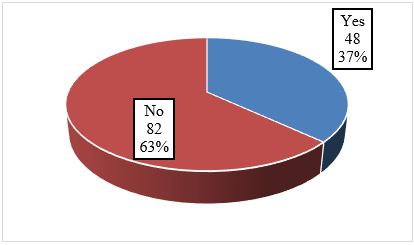
Figure 1: Frequency of Hypocalcemia
Table II: Comparison of hypocalcemia in age and Gender strata |
||||
|
Hypocalcemia |
P value |
||
Yes |
No |
|||
Age (months) |
2-12 month |
27(43.5%) |
35(56.5%) |
0.135 |
13-24 month |
21(30.9%) |
47(69.1%) |
||
Gender |
Male |
31(39.2%) |
48(60.8%) |
0.464 |
Female |
17(33.3%) |
34(66.7%) |
||
children had hypocalcemia. The difference between both age strata was insignificant (p>0.05) Table II. Data was stratified for gender of children. 31(39.2%) male children had hypocalcemia and 17 (33.3%) female children had hypocalcemia. The difference between both gender strata was insignificant (p>0.05) Table II.
Seizures are common neurological disorder in pediatric population.7 4-10% of children experience at least one episode of seizures in their life. The incidence is much higher in children under the three years of age.10 Seizures are the occurrence of signs and symptoms resulting from high neuronal electrical activity in brain leading to increased muscle tone, movement, abnormal sensations and state of awareness.11 There are many causes of afebrile seizures including metabolic disturbances, among them hypocalcemia is most common.8 Calcium plays a pivotal in the release of neurotransmitters at synaptic membranes, neuromuscular junction and muscle contraction. Hypocalcemia decreases the threshold needed for activation of neurons thus leading to increased neuromuscular excitability.12
In our study we found 48( 36.9%) patients with hypocalcemia out of 130 presenting with afebrile seizures compared to a local study by Khan et al which showed 41(68.3%) out of 60 cases with hypocalcemic seizures.2 Another local study showed 66.48% burden of disease.1 Another study by Rahman et al showed hypocalcemia as a cause in afebrile seizures in 21(24.7%) out of 85 children which is consistent with our results.8 A study conducted in Egypt showed 28% of breast fed infants of vitamin D deficient mothers to have hypocalcemic seizures.14 In our study the average age of children was 13.03±6.81months in which most of them were under 15 months of age which is in contrast to Khan et al which showed most cases under 6 months of age with average age being 7.5 ± 1.34 months.2 Our study showed slight male predominance pattern of disease with 79 (60.76%) males which is comparable with Khan et al (56%)2 and Rahman et al (52.98%)17 whereas Sharma et al., didn`t find gender difference.18 Generalized tonic clonic seizures were observed in most cases, as shown in a study by Sharma et al (90%).16
Hypocalcemia is a common problem in our population due to lack of awareness of the consequences it has on child`s life.2 Many causes of hypocalcemia are preventable like Inadequate sun exposure leading to development of vitamin D deficiency, unfortified formula milk, cow milk without vitamin D supplementation, inappropriate weaning.8 Breast fed infants are also at increased risk of hypocalcemia if mother is vitamin D deficient.14 Maternal factors like anemia , multi parity, maternal age, and less child spacing, poverty are also major contributing factors for this in our society.1
We conducted this study to high light burden of hypocalcemia and its consequences (hypocalcemic seizures) in our population and to identify them in time, treat and prevent its complications.
It has been concluded that frequency of hypocalcemic fits is high in children with afebrile seizures. Thus, we have got the local evidence regarding hypocalcemia in children with afebrile seizures. Now we recommend screening of all children from 2 months to 2 years of age with afebrile seizures for hypocalcemia.
- Rehman M, Bajwa FE, Mushtaq MA, Sarwar I, Amir S, Nawaz R. AFEBRILE SEIZURES. The Professional Medical Journal 2019;26(05):836-40. https://doi.org/10.29309/TPMJ/2019.26.05.3488
- Khan MA, Iqbal SMJ, Afzal MF, Sultan MA. Frequency of Hypocalcemic Fits in Children Presenting with Afebrile Seizures and Risk Factors for Hypocalcemia –A Descriptive Study. Annals of King Edward Medical University 2011;17(1):31-. https://doi.org/10.21649/akemu.v17i1.266
- Bitaraf M, Pourazizi M, Bavarian B, Sotoudei A, Pour AR, Rabbani A, et al. Hypocalcemic seizure and related factors after neonatal period; A single-center, retrospective study. Archives of Advances in Biosciences 2014;5(3). https://doi.org/10.22037/jps.v5i3.7401
- Balasubramanian S, Dhanalakshmi K, Amperayani S. Vitamin D deficiency in childhood—A review of current guidelines on diagnosis and management. Indian pediatrics 2013;50(7):669-75. https://doi.org/10.1007/s13312-013-0200-3
- Tekin M, Konca Ç, Gülyüz A. Hypocalcemic convulsion in a six-year-old child with vitamin D deficiency. Eurasian Journal of Emergency Medicine 2014;13(4):206. http://dx.doi.org/10.5152/jaem.2014.251
- Salama MM, El-Sakka AS. Hypocalcemic seizures in breastfed infants with rickets secondary to severe maternal vitamin D deficiency. Pakistan journal of biological sciences: PJBS 2010;13(9):437-42. https://doi.org/10.3923/pjbs.2010.437.442
- Fayyaz J, Rehman A, Hamid A, Khursheed M, Zia N, Feroze A. Age related clinical manifestation of acute bacterial meningitis in children. Journal of Pakistan Medical Association 2014;64(3):296. PMID: 24864603.
- Rahman W, Lohana H, Urooj S, Ahmed S, Moeed A, Humayun K. Frequency of Hypocalcemic Fits in Children 2 Months to 2 Years of Age, Presenting with the First Episode of Afebrile Seizures at Hospital Settings in Urban Pakistan: A Cross-Sectional Study. Open Journal of Pediatrics 2020;10(3):411-22. http://dx.doi.org/10.4236/ojped.2020.103042
- Bande B, Agrawal A. Study of incidence of hypocalcemia in infants admitted with seizures in a tertiary care hospital. Indian Journal of Child Health 2018;5(11):674-7.
- Gowda VK, Kulhalli Jr P, Benakappa Sr N, Benakappa A. Etiological profile of afebrile seizures in infants in a tertiary care center from southern India. Journal of pediatric neurosciences 2019;14(2):82. https://doi.org/10.4103%2Fjpn.JPN_61_18
- Behrman RE, Vaughan III VC. Nelson textbook of pediatrics: WB Saunders company; 1983.
- Jones BL, Smith SM. Calcium-sensing receptor: a key target for extracellular calcium signaling in neurons. Frontiers in physiology 2016;7:116. https://doi.org/10.3389/fphys.2016.00116
- Julliard A, Al Koborssy D, Fadool DA, Palouzier-Paulignan B. Nutrient sensing: another chemosensitivity of the olfactory system. Frontiers in physiology 2017;8:468. https://doi.org/10.3389%2Ffphys.2017.00468
- Fuleihan GE-H. Vitamin D deficiency in the Middle East and its health consequences for children and adults. Clinical Reviews in Bone and Mineral Metabolism 2009;7(1):77-93. https://doi.org/10.1007/s12018-009-9027-9
- Chowdhury RM, Alam B, Sharma ZD, Das KP, Hossain MZ, Deb SR. Risk Factors and Clinical Profile of Seizure in Childhood. Journal of Dhaka Medical College 2012;21(2):211-7. https://doi.org/10.3329/jdmc.v21i2.15361
- Sharma A, Virmani DN. Ricket in walled city of Delhi. Indian Paediatr 2004; 41 (10) 1076-1.

An Official Publication of
Islamabad Medical & Dental College
Volume 13 Issue 2
Address of Correspondence
Isma Waheed
Email:
isma.waheed@gmail.com
Authors’ Contribution: 1,2Conception; Literature research; manuscript design and drafting; 3,4 Critical analysis and manuscript review; 5Data analysis; Manuscript Editing.
Cite this article. Sultana S, Waheed I, Ahmad SM, Qureshi MN, Siddiqui TS. Frequency of Hypocalcemic Seizures in Children with Afebrile Seizure: From 2 months - 2 years in a Tertiary Care Hospital. J Islamabad Med Dental Coll. 2024; 13(2): 199-202.
DOI: https://doi.org/10.35787/jimdc.v13i2.997