Anxiety Experienced by People Searching Internet for Medical Information
Mohi Ud Din1, Syed Fawad Mashhadi2, Shahrob Khan3, Tehreem Safdar4, Bilal Ashraf5, Zeeshan Khalid Awan6
1 Assistant Professor, Community Medicine, Aziz Fatima Medical and Dental College, Faislabad
2Associate Professor, Community Medicine, Army Medical College, Rawalpindi
3, 4, 5, 63,4,5,6Final Year MBBS Student, Army Medical College, Rawalpindi
Background: A large proportion of people use internet to search for information on medical symptoms. The objective of the study was to assess the frequency of internet use for medical information and its association with anxiety levels.
Methodology: A cross-sectional study was conducted in tertiary care hospitals affiliated with National University of Medical Sciences, Islamabad from August to December 2020. Ethical approval was taken. A total of 414 Participants aged 20 and above, belonging to either gender, and having at least primary level education were included in the study, while participants belonging to medical background were excluded. Non-probability convenient sampling technique was used to collect data through a validated questionnaire. Frequencies and percentages were calculated. Chi-square test of significance was applied. P-value less than .05 was considered as statistically significant.
Results: : Majority i.e. 301 (80%) of the participants stated that the health-related searches exacerbated their anxiety. Participants from lower income groups were more prone to anxiety, while participants from higher income groups were more likely to visit a doctor. There was a significant association between age groups and perceptions, that and web searches lead to review of content on serious illness, persistence of query for illness after web search, and increase in web searches related to perceived condition (p<0.05).
Conclusion: There was an increase in Anxiety levels after web searches. It was more pronounced in lowest income group people. Higher income group were more likely to trust web searches results.
Keywords: Anxiety, Internet, Information, Medical
Health anxiety is defined as “an obsessive and irrational worry about having a serious medical condition”. As many as 17 to 25% of patients suffer from it and web searches have the potential to aggravate this anxiety1. More than 30% of the population of Pakistan have access to the internet, and more than 50% own a cell phone1.
Many people use the internet for health-related searches. In fact the practice is so common that researchers have coined a term for it: “cyberchondria.” 3, 4. While numerous researches have been conducted, in other countries on the possible harms and benefits of this deluge of information, no comprehensive study on this topic has been carried out in Pakistan. In a country with a rapidly expanding IT sector, the effects of this democratization of medical knowledge could be momentous5.
The possible benefits include greater medical literacy among the general public, improvement in doctor-patient interactions, ease of access, and more privacy in searching information about embarrassing medical conditions6. The internet also provides people with support groups that can possibly help in the social and psychological aspect of the health-related condition7.
There are also many potential harms. It is a fact that online symptom checkers are often not reliable8. The information available online is not regulated9.
In a country like Pakistan, which has a literacy rate of around 57 percent, this abundance of misinformation can expose a scientifically illiterate population to unsound medical practices and beliefs. Social networking websites are inundated with advertisements for dubious medications that offer cures for everything from hair-loss to impotence to obesity. There are online groups and forums that provide a bubble of delusion to people who believe in things as flat out wrong as the “anti-vax” movement, the supposed benefits of anorexia, and the efficacy of juices and oils in “detoxing” the body and curing it of ailments as serious as cancer10. If such false beliefs can take root in developed, educated western countries, then who knows how insidious this dissemination of misinformation could be for a country lagging in literacy as Pakistan.
A patient’s lack of knowledge and poor information provided by a website are the two factors that can turn the internet into a destructive tool for the patient11. In practice it is very hard to stop people from uploading untrustworthy information. What we can do is educate the populace on how to use the internet to their benefit: what websites they can trust, what information they can rely on, and for what issues they need to consult a doctor. Maybe our government can even invest in an IT programme dedicated to developing medical tools that are trustworthy and easily accessible by the general public.
With an increasing proportion of the population using the internet, the implications could be far-reaching. The aim of this study was to assess the frequency of internet use for medical information seeking by the general public and its association with anxiety levels.
A cross-sectional study was conducted in tertiary care hospitals affiliated with National University of Medical Sciences, Islamabad from August 2020 to December 2020. The total sample size was calculated using Raosoft sample size calculator with 95% confidence level, 5% margin of error, and 10% dropout, it was computed to be 41412. About 29 responses were found to be invalid making the total sample size to be 385. Participants aged 20 and above, belonging to either gender, and having at least primary level education, visiting the hospitals during the study period and willing to participate in the study were included in the study while the participants with medical background were excluded from the study. Non-probability convenient sampling technique was used for selection of study participants from outpatient departments. Questionnaire used was adopted from a study on cyberchondria by Ryen W. White et al13, modified according to the demographics of our population and a pilot study was conducted to check its appropriateness in 5% of anticipated sample size. Crohn bach alpha score measured for different items of the questionnaire was found to be within a range of 0.7-0.8. Time required to complete the questionnaire was 15 min. The questionnaire was translated in Urdu language before distribution and it consisted of four sections; demographic data, questions regarding web searches, conditions that have not been diagnosed and effect on behavior. The data was analysed using IBM SPSS Statistics Version 25. Frequencies and percentages were calculated. Chi-square test of significance was applied. P-value less than 0.05 was considered as statistically significant. Ethical approval was taken from ethical approval committee of army medical college to which these hospitals are affiliated.
Out of 414 participants, 29 responses were found to be invalid. Therefore, analysis was done on the responses of 385 participants. Majority i.e., 158(41%) belonged to the age group 20 – 25 years, 41 (10.6%) to 26 – 30 years, 96 (24.9%) to 31 – 35 years and 90 (23.4%) to 36 years and above. There were 209 (54.3%) females and 176 (45.7%). Most of the participants i.e., 204 (53%) were having graduation and above level of education while majority i.e., 160 (41.6%) were earning upto Rs.25,000 per month and 120 (31.2%) upto Rs.50,000. A total of 370 (96.1%) participants were using Google as the web search engine while 1 – 5 average web searches per month were done by 304 (79%) participants, 6 – 10 by 56 (14.5%), 11 – 15 by 7 (1.8%) and more than 16 web searches were done by 18 (4.7%) of the participants.
Web searches after getting concerned about their health was done by 228 (59.2%) of the participants. Internet query of the sample population comprised of 3 types i.e., 188 (48.8%) participants searched through combination of words containing both symptoms and medical conditions; 100 (26%) of sample population searched through words representing symptoms only while 97 (25.2%) participant’s searched through words that describe medical conditions only. Most of the study participants generally searched for information about common diseases comprising 232 (60.3%) of the total sample size while 95 (24.7%) searched for information on serious medical conditions (e.g. cancer, myocardial infarction). A total of 58 (15%) of the sample population searched for the forums and pages describing about other’s experience about the particular disease. Different web searches may have differences in describing medical conditions and same was experienced by most of the participants i.e., 224 (58.2%) while remaining did not observe such difference. Table 1 shows the effect of webs search on perceptions of participants regarding their illness and whether it interrupted their routine activities or not.
Table 1: Participants’ Perception about Web Searches |
||||||
Variable |
Always |
Often |
Occasionally |
Rarely |
Never |
Total |
Ranking of web search result indicate likelihood of illness |
31 (8.1%) |
110 (28.6%) |
125 |
83 (21.6%) |
36 |
385 |
Web search lead to review of content on serious illness |
43 |
105 |
121 |
92 |
24 |
385 |
Query for illness persist |
20 |
86 |
128 |
114 |
37 |
385 |
Perception of illness interrupted online activities |
23 |
85 |
94 |
115 |
68 |
385 |
Perception of illness interrupted other activities |
25 |
80 |
101 |
106 |
73 |
385 |
52.2%(201) of the participants used web search as a medical expert system, 62%(239) had a perception that web search engine escalates medical concerns while 21% (81) mentioned an increase in anxiousness due to web searches. There are different factors which contributed to anxiety after web searches among participants. The most common one was mention of more serious explanations of their medical conditions or symptoms (n=90, 23.4%) as shown in table 2.
Table 2: Factors related to anxiety after internet search by participants |
||
What contributed to anxiety |
Frequency |
Percent |
Reliability of source |
55 |
14.3 |
Mention of more serious explanations |
90 |
23.4 |
Mention of more serious and few non-serious explanations |
62 |
16.1 |
Presence of escalatory terminology |
72 |
18.7 |
Presence of complex medical terminology |
25 |
6.5 |
No anxiety |
81 |
21.1 |
Total |
385 |
100 |
Different behaviour patterns of the participants due to web searches such as becoming hypochondriac, taking an appointment, increased searches related to perceived condition are shown in Fig 1.
Figure 1: Effect of Web Searches on Behaviour Patterns of Participants.
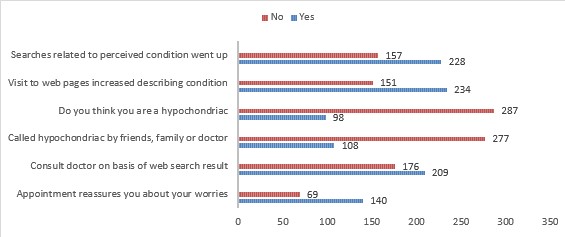
There was significant association between age groups and perception that, web searches lead to review of content on serious illness (p = 0.022); query for illness persists after web search (p = 0.004), and web searches related to perceived condition increased (p = 0.039). Also, differences in males and females were observed related to web searches; females found to be more anxious than males, web searches related to perceived conditions went up more in females and also visit to web pages describing condition increased more in females as compared to males but these differences were statistically insignificant.(Table 3)
Web searches lead to review of content on serious illness |
||||||||
|
|
Always |
Often |
Occasionally |
Rarely |
Never |
Total |
p-value |
Age groups |
20-25 |
24 |
47 |
36 |
41 |
10 |
158 |
0.022 |
26-30 |
6 |
9 |
13 |
10 |
3 |
41 |
||
31-35 |
10 |
31 |
31 |
21 |
3 |
96 |
||
>36 |
3 |
18 |
41 |
20 |
8 |
90 |
||
Query for illness persist |
||||||||
|
|
Always |
Often |
Occasionally |
Rarely |
Never |
Total |
p-value |
Age groups |
20-25 |
17 |
32 |
46 |
49 |
14 |
158 |
0.004 |
26-30 |
1 |
15 |
12 |
8 |
5 |
41 |
||
31-35 |
0 |
15 |
38 |
34 |
9 |
96 |
||
>36 |
2 |
24 |
32 |
23 |
9 |
90 |
||
Web searches related to perceived condition increased |
||||||||
|
|
Yes |
No |
p-value |
||||
Age groups |
20-25 |
102 |
56 |
0.039 |
||||
26-30 |
||||||||
31-35 |
||||||||
>36 |
||||||||
Search made u more anxious |
||||||||
|
|
Yes |
No |
p-value |
||||
Gender |
Male |
135 |
40 |
0.38 |
||||
Female |
169 |
40 |
||||||
Searches related to perceived condition increased |
||||||||
|
|
Yes |
No |
p-value |
||||
Gender |
Male |
97 |
79 |
0.15 |
||||
|
Female |
131 |
78 |
|||||
Visit to web pages describing condition increased |
||||||||
|
|
Yes |
No |
p-value |
||||
Gender |
Male |
103 |
72 |
0.46 |
||||
|
Female |
131 |
78 |
|||||
Usefulness of the internet as a healthcare tool and devising methods for improving the quality of the health-related information reaching the general public through the web is needed more than ever, nowadays14.This study investigated the use of the internet by the general public, to look up for the symptoms of a perceived medical condition and making self-diagnosis.
A research done by Teresa Loda et al showed that participants found reliable medical knowledge online irrespective of the type of search engine while in this study, most of the participants (96.1%) used Google15. Majority, in this study were of the opinion that no particular search engine was more likely to escalate medical concerns. A study conducted by Liupu Wang et al showed Google to have the best search validity (in terms of whether a website could be opened), however Bing had the highest score for usefulness16. Most of the participants of our study using internet for medical purpose had education till graduation or above and having lower income i.e. up to Rs.25000 per month. A study conducted by Fabienne Reiners et al showed that high internet prevalence is associated with people having higher income and that the participants with higher education use internet more for medical purpose than those with lesser education17. People from the lowest income group were slightly more likely to feel anxious after a web search. This is consistent with a previous study conducted by Kate Muse et al which showed that anxiety was more prevalent among low income groups18. A study done by Teresa Loda et al showed that participants searched the internet on the basis of specific medical terms. This is in contrast to our study where participants internet search included symptoms also with medical terms15.
A study conducted by Ryen W. White et al concluded that at least three quarters of the participants, suspected of having an illness, based on the results of web searches. This is similar to our study where more than 90% of our participants had a similar perception. A similar proportion of their subjects used web search as a health expert system in their study while only 48% of our participants did19.
Several previous studies have found a positive correlation between health anxiety and online health information seeking, such as the twenty studies analysed by McMullan and Berle et al20. Majority (79%) of the subjects of our study stated that their anxiety was exacerbated after the web searches and that there is a positive relationship between anxiety and web searches. Aiken and Kirwan et al also found a positive relationship between looking up symptoms online and health anxiety. The same study found a positive correlation between anxiety and review of content on serious illnesses21. A similar Doherty-Torstrick study found that longer duration online health related use was associated with “increased functional impairment, less education, and increased anxiety which is similar to our study”22.
Majority of the study participants said that searching the web for health-related information made them feel more anxious about a perceived medical condition. This might vary with the nature of the condition under consideration. The results of our study showed that women were more likely to behave differently with regard to a medical condition after the web search, to review content on serious illnesses, to feel uncomfortable in bringing their own research to the health professional, and to feel that their other activities had been interrupted by the web search. A study conducted by Dalia M Corrales et al also showed that internet use for searching medical conditions is common among women, and its use is associated with increased anxiety23. Engagement with physicians went up to a greater extent for people from higher income groups. This is similar to the results of our study. This finding is similar to that of studies of iniquity in doctor utilization in developed countries which showed that people having a higher income are more likely to visit physicians and specialists24.
A little is known about the use of web searches by general public for medical information purposes so this study will add to the existing body of knowledge. Non-probability convenience sampling was used, so the sample might not be representative of the population. Also, the Psychiatric history of subjects was not taken. Further research should be done on this to see the positive impact of the use of internet, in terms of the knowledge it provides regarding medical information.
Most of the participants experienced increase in anxiety levels after web searches for their medical conditions. The effect was more pronounced in lowest income group people. Higher income group were more likely to trust web searches results.
- Ayers JW, Leas EC, Johnson DC, Poliak A, Althouse BM, Dredze M, et al. Internet Searches for Acute Anxiety During the Early Stages of the COVID-19 Pandemic. JAMA Intern Med. 2020;180(12):1706-7. doi:10.1001/jamainternmed.2020.3305
- Iftikhar S, Saqib A, Sarwar MR, Sarfraz M, Arafat M, Shoaib Q-u-a. Capacity and willingness to use information technology for managing chronic diseases among patients: A cross-sectional study in Lahore, Pakistan. PLoS ONE. 2019;14(1):e0209654. doi: 10.1371/journal.pone.0209654
- Starcevic V, Schimmenti A, Billieux J, Berle D. Cyberchondria in the time of the COVID‐19 pandemic. Hum. behav. emerg. 2021;3(1):53-62. doi: 10.1002/hbe2.233
- Jungmann SM, Witthöft M. Health anxiety, cyberchondria, and coping in the current COVID-19 pandemic: Which factors are related to coronavirus anxiety? J. Anxiety Disord. 2020;73:102239. Doi:10.1016/j.janxdis.2020.102239
- Akhtar M, Fatima T. Exploring cyberchondria and worry about health among individuals with no diagnosed medical condition. J Pak Med Assoc. 2020;70(1):90-5. doi: 10.5455/JPMA.8682
- Taylor C, Graham AK, Flatt RE, Waldherr K, Fitzsimmons-Craft EE. Current state of scientific evidence on Internet-based interventions for the treatment of depression, anxiety, eating disorders and substance abuse: an overview of systematic reviews and meta-analyses. Eur. J. Public Health. 2020. Doi:10.1093/eurpub/ckz208
- Griffiths KM. Mental health Internet support groups: just a lot of talk or a valuable intervention? World psychiatry. 2017;16(3):247. doi: 10.1002/wps.20444
- Semigran HL, Linder JA, Gidengil C, Mehrotra A. Evaluation of symptom checkers for self diagnosis and triage: audit study. bmj. 2015;351:h3480. Doi:10.1136/bmj.h3480
- Liu S-H. Relationship between the factors influencing online help-seeking and self-regulated learning among Taiwanese preservice teachers. Comput. Hum. Behav. 2017;72:38-45. Doi:10.1016/j.chb.2017.02.034
- Kanekar AS, Thombre A. Fake medical news: avoiding pitfalls and perils. Fam Med Community Health. 2019;7(4):e000142-e. doi: 10.1136/fmch-2019-000142
- Robertson N, Polonsky M, McQuilken L. Are my symptoms serious Dr Google? A resource-based typology of value co-destruction in online self-diagnosis. Australas. Mark. J. 2014;22(3):246-56.Doi:10.1016/j.ausmj.2014.08.009
- Raosoft. Sample size calculator. 2022; Available from: http://www.raosoft.com/samplesize.html.
- White RW, Horvitz E, editors. Experiences with web search on medical concerns and self diagnosis. AMIA Annu Symp Proc. 2009 Nov 14;2009:696-700
- Mian A, Khan S. Coronavirus: the spread of misinformation. BMC Med. 2020;18(1):1-2. Doi:10.1186/s12916-020-01556-3
- Loda T, Erschens R, Junne F, Stengel A, Zipfel S, Herrmann-Werner A. Undergraduate medical students’ search for health information online: explanatory cross-sectional study. JMIR Med. Inform. 2020;8(3):e16279. doi: 10.2196/23253
- Wang L, Wang J, Wang M, Li Y, Liang Y, Xu D. Using Internet search engines to obtain medical information: a comparative study. J. Med. Internet Res. 2012;14(3):e74. doi: 10.2196/jmir.1943
- Reiners F, Sturm J, Bouw LJW, Wouters EJM. Sociodemographic Factors Influencing the Use of eHealth in People with Chronic Diseases. Int. J. Environ. Res. Public Health. 2019;16(4):645. Doi:10.3390/ijerph16040645
- Muse K, McManus F, Leung C, Meghreblian B, Williams JMG. Cyberchondriasis: fact or fiction? A preliminary examination of the relationship between health anxiety and searching for health information on the Internet. J. Anxiety Disord. 2012;26(1):189-96. Doi:10.1016/j.janxdis.2011.11.005
- White RW, Horvitz E. Evaluation of the feasibility of screening patients for early signs of lung carcinoma in web search logs. JAMA Oncol. 2017;3(3):398-401. doi:10.1001/jamaoncol.2016.4911
- McMullan RD, Berle D, Arnáez S, Starcevic V. The relationships between health anxiety, online health information seeking, and cyberchondria: Systematic review and meta-analysis. J. Affect. Disord. 2019;245:270-8. Doi:10.1016/j.jad.2018.11.037
- Aiken M, Kirwan G, Berry M, O’Boyle CA. The age of cyberchondria. R. Coll. Surg. Irel. stud. med. j. 2012;5(1):71-4.
- Doherty-Torstrick ER, Walton KE, Fallon BA. Cyberchondria: parsing health anxiety from online behavior. Psychosomatics. 2016;57(4):390-400. Doi:10.1016/j.psym.2016.02.002
- Corrales DM, Wells AE, Radecki Breitkopf C, Pena G, Kaplan AL, King LS, et al. Internet use by gynecologic oncology patients and its relationship with anxiety. J. Health Commun. 2018;23(3):299-305. Doi:10.1080/10810730.2018.1442529
- Papanicolas I, Woskie LR, Jha AK. Health care spending in the United States and other high-income countries. Jama. 2018;319(10):1024-39. doi:10.1001/jama.2018.1150.

An Official Publication of
Islamabad Medical & Dental College
Volume 11 Issue 1
Authors’ Contribution
1Conception; Literature research; manuscript design and drafting; 2, Critical analysis and manuscript review; 3 Data analysis; 4Manuscript Editing.5,6
Article info
Received: April 28, 2021
Accepted: March 24, 2022
Address of Correspondence
Mohi Ud Din
Email:
dr.md89@outlook.com
Cite this article. Mohi UD, Mashhadi SF, Khan S, Safdar T, Ashraf B, Awan ZK. Anxiety Experienced By People Searching Internet For Medical Information. J Islamabad Med Dental Coll. 2022; 11(1):25-29. DOI: 10.35787/jimdc.v11i1.711
Funding Source: Nil
Conflict of Interest: Nil